Sovereignty
A Mesh That Gets Stronger With Every Home That Joins
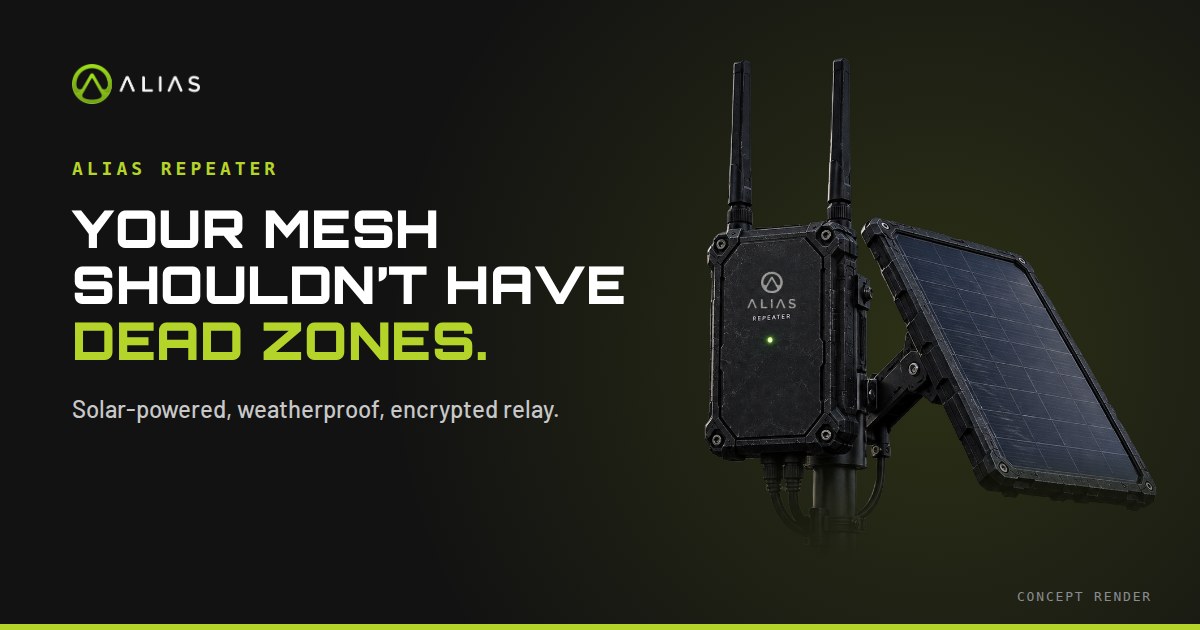
Images show concept renders. Final hardware may differ.
Every network you've used your whole life gets worse as more people join it. More phones on a cell tower means slower calls. More devices on a Wi-Fi router means buffering. More users on a service means a company throttling you, rate-limiting you, or quietly changing the terms because the infrastructure — and the control — always belonged to someone else.
A LoRa mesh flips that relationship. It doesn't get weaker as it grows. It gets stronger.
Here's the mechanic, in plain terms: every Alias device on a mesh network isn't just an endpoint sending and receiving messages — it's also a relay. A message that can't reach its destination in one hop finds another device to bounce through, and another, until it arrives. One Rogue typically reaches 12+ miles with a clear line of sight, less in hills or heavy trees. Ten devices spread across a neighborhood give you a network with no center, no chokepoint, and no company standing in the middle deciding whether your message gets through today.
That's the entire idea behind Alias hardware built specifically to extend that mesh — not to talk on it, but to strengthen it. A dedicated repeater node does one job: it sits somewhere with a good vantage point, stays powered, and quietly extends how far a signal can travel before it needs another hop. It doesn't replace Rogue, and it isn't trying to be a phone. It's infrastructure, in the truest sense — the kind of thing you install once and mostly forget about, except for the fact that it makes every device on the network a little more capable of reaching a little further.
Picture a rural road with houses spaced far enough apart that a direct signal between the two ends wouldn't make it. Add a repeater at the midpoint — on a barn roof, a fence post, wherever line-of-sight is best — and suddenly that whole stretch of road is one mesh instead of two isolated pockets. Now picture that same idea scaled to a neighborhood, a ranch, a stretch of coastline that loses cell service every hurricane season. The people who put up repeaters aren't just helping themselves. They're extending the floor everyone else stands on.
This is what we mean when we say a mesh gets stronger with every home that joins it. It's not a slogan — it's the literal physics of relay networking, and it's the opposite of everything else you've been trained to expect from a network. No carrier decides the coverage map. No company can shut it off from a headquarters somewhere. The people who build it are the people who use it, and every device — whether it's in someone's hand or bolted to a post — makes the whole thing more resilient than it was before.
That's sovereignty at the infrastructure layer. Not a promise on a spec sheet. A network you can watch get stronger, one honest node at a time.