Company News
Four Years, Two Pivots, One Mission: The Story of Alias Rogue
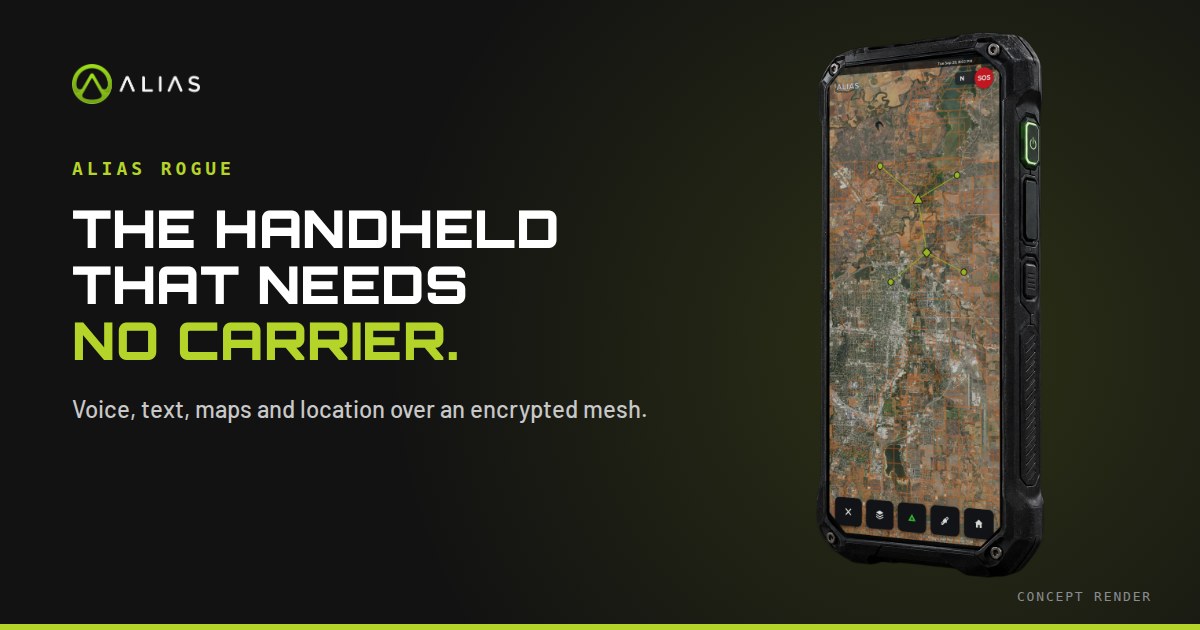
Images show concept renders. Final hardware may differ.
The Alias Rogue we're building today is the third major iteration of the same core idea. It's better than what we originally designed. It's also harder to build, more expensive to manufacture, and took two full pivots to get right.
This is the story of how we got here.
2022: The First Prototype - Simple Mesh, Big Ambitions
The original Rogue was a walkie-talkie replacement. Push-to-talk voice over LoRa mesh. Battery-powered, rugged case, simple UI. The pitch: give families and small teams a way to stay connected across their property without cell service.
We built a working prototype in six months. It transmitted text. The range was decent. People who tested it liked the idea. But when we showed it to our target users - rural landowners, off-grid families, search and rescue teams - the feedback was unanimous:
"This is great for text. But what about voice? What about knowing where my people are? What about integrating with the cameras and sensors I already have?"
They didn't want a walkie-textie. They wanted a platform.
2023: The First Pivot - Adding Smarts, Hitting Limits
We went back to the drawing board. Rogue v2 added a touchscreen, text messaging, group location sharing, and basic home automation hooks. You could trigger a relay, unlock a door, check a sensor - all over the same mesh.
It was better. But it exposed a fundamental problem with standard LoRa radios: half-duplex transmission.
When a LoRa device transmits, it goes deaf. It physically cannot receive while sending. For a walkie-talkie, that's fine - you only talk or listen, never both at once. But for a platform handling voice, text, location updates, and sensor alerts? Half-duplex became a bottleneck.
We tried software tricks. Time-division multiplexing, aggressive buffering, priority queues. It helped, but it didn't solve the core issue: you can't have a real-time communication platform when your radio can only do one thing at a time.
By late 2023, we had a choice: ship a product that worked okay, or rebuild it to work right.
2024: The Second Pivot - Full-Duplex or Bust
In early 2024, we made the decision that defined Rogue's final architecture: dual-radio full-duplex.
Instead of one LoRa transceiver doing double duty, Rogue would run two dedicated SX1262 radios on separate frequencies. One always transmits. One always receives. Frequency-division duplex means both can run simultaneously without interfering.
It solved the bottleneck. It also made the hardware twice as complex, the power budget tighter, and the RF design significantly harder. But when we tested it, the difference was night and day:
98.5% two-way delivery reliability vs ~60% with half-duplex under load
170ms ACK round-trip vs 366ms half-duplex average
Zero missed alerts during simultaneous voice calls
We spent the rest of 2024 and early 2025 refining the design. Custom hardware, Firmware from our dedicated software engineering team. Months of field testing. The device that emerged wasn't just better - it was fundamentally different from anything else in the consumer mesh radio space.
2025-2026: Manufacturing Hell and Light at the End
Getting full-duplex LoRa to work in a lab is one thing. Manufacturing it at scale is another.
We hit every supply chain problem you can imagine: component shortages, lead time blowouts, vendor flakes, and the memory cost explosion. Our Hardware and Software partners earned every dollar - they stuck with us through multiple board revisions and many antenna redesigns.
By late 2025, we had a device that worked. By early 2026, we had a device we could build. By mid 2026, we had a device we could ship.
The Rogue we're taking to launch is everything we wanted the first prototype to be: a true mesh platform, not a glorified radio. Voice, text, location, and sensor integration - all working simultaneously, all encrypted end-to-end, all running on infrastructure you control.
What Rogue Changes
Rogue isn't just a handheld. It's the foundation for what comes next:
Home automation without the cloud. Your cameras, locks, sensors, and alarms talk to each other over the same mesh Rogue runs on. No subscription. No cloud account. No vendor watching.
Community mesh that actually scales. Full-duplex means mesh nodes can relay traffic without going deaf. Neighborhoods, farms, compounds - Rogue is the backbone that makes multi-hop networks practical.
Emergency comms that work when nothing else does. No cell service, no internet, no problem. When the grid goes down, Rogue keeps your people connected.
The smart home industry built itself on convenience at the cost of privacy. Ring doorbells upload footage to Amazon. Nest thermostats feed data to Google. August locks require a cloud account to function.
Rogue is the first piece of a different vision: infrastructure you own, running on networks you control, storing data on hardware you can touch.
What We Learned
Four years from first prototype to production taught us a few things:
Listen to your early users. The pivot from walkie-talkie to platform came from actual use-case feedback, not our assumptions.
Don't ship broken fundamentals. Half-duplex was a known constraint. We could have shipped it and called it good enough. We didn't, and Rogue is better for it.
Hardware is hard. Software you can patch. The hardware you have to get right before it leaves the factory. We took the time to get it right.
The mission matters more than the timeline. We could have shipped a mediocre product in 2024. We chose to take the time to ship a great one. That was the right call.
What's Next
Rogue comes first. Homebase, the central hub for your property, follows it. Cameras, locks and environmental sensors are further out. In the meantime, Rogue works with Matter devices over Thread, so you can start building your network now and keep your devices from phoning home. We haven't announced dates yet; join the waiting list and you'll be among the first to hear.
Every device builds on the same mesh architecture Rogue pioneered. Every device stores data locally unless you explicitly choose otherwise. Every device answers to you.
Four years ago, we set out to build private communication infrastructure that people actually own. The path took longer than we expected. The product is better than we imagined.
If you've been waiting for sovereign communication that actually works, your wait is almost over.
“Built for us, shared with you.” — Alias Communication Solutions