Product Updates
Two Radios, One Conversation: Why Rogue Talks and Listens at Once
Images show concept renders. Final hardware may differ.
Pick up almost any long-range radio built for off-grid communication and you'll run into the same wall: it can transmit, or it can receive, but not both at the same time. Push-to-talk radios have trained a generation of users to accept that trade-off as just how radio works. Say your piece, release the button, wait for a reply.
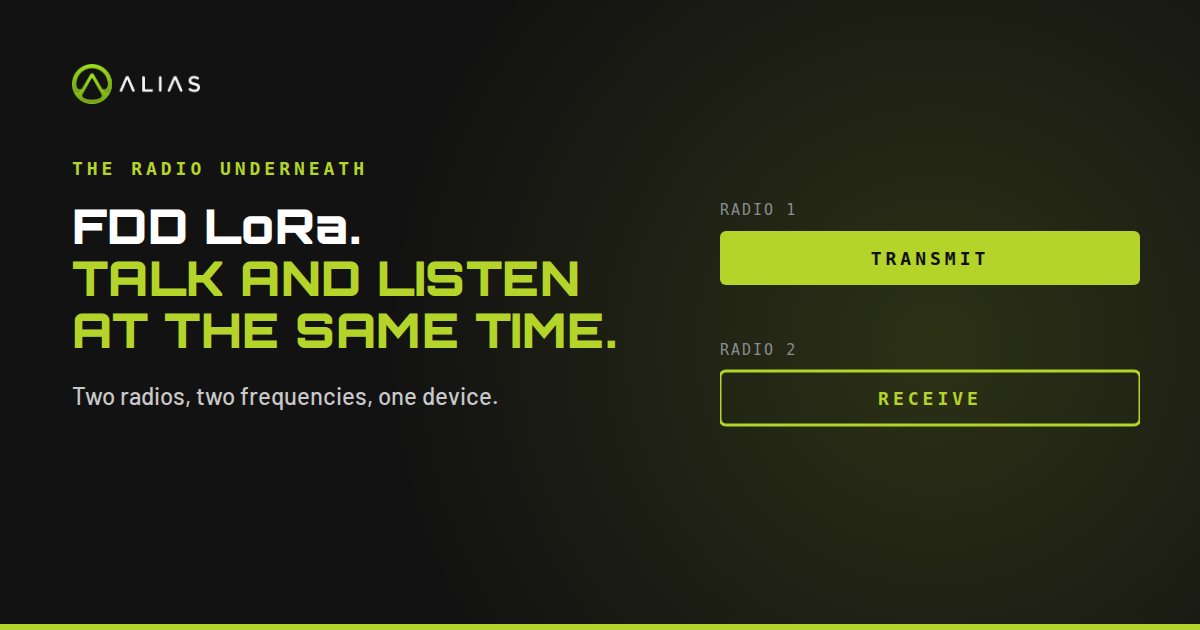
Rogue doesn't accept that trade-off, because it doesn't have to. Under the hood, Rogue runs two independent LoRa radios instead of one — a full-duplex design that lets the device transmit and receive simultaneously, on the same mesh, without stepping on itself. We filed a provisional patent on the approach because as far as we can tell, nobody else building consumer mesh hardware has shipped it. Most of the industry hasn't tried, because doubling the radios sounds like doubling the cost and the complexity. We decided that was worth it.
Here's why it matters in practice, not just on a spec sheet. A single-radio mesh device is fundamentally a queue. Every packet — your message, a relay hop from three houses over, a location update from someone on a hike — competes for the same half-duplex channel time. Add a few active nodes and that queue gets long fast. Full-duplex changes the math: Rogue can be relaying someone else's message through the mesh at the exact moment it's receiving your next one, instead of choosing between the two. The network doesn't get slower as more people join it — because more devices extending a full-duplex mesh means more paths for a signal to travel, not more contention for one narrow channel.
Think about what that means for the actual use cases that make mesh communication worth having in the first place. A family spread across a property during a storm, checking in one after another, expects those messages to move in near-real time — not to queue up behind whoever transmitted first. A group coordinating on a remote trail wants updates to feel like a conversation, not a radio-operator relay. None of that requires the internet, a cell tower, or a subscription. It requires a device honest enough to run two radios instead of cutting corners on one, and a mesh — built on Reticulum, with 12+ miles typical line of sight per hop on Rogue — that gets stronger with every device that joins it.
This is the kind of decision that defines Alias as a company more than any single feature does. We could have shipped a single-radio device, called it good enough, and it would look nearly identical on a marketing page. We didn't, because "nearly identical" isn't sovereignty. Sovereignty means the infrastructure actually works the way you were told it would — under load, in the moment it matters, with nobody else's server standing between your words and the person who needs to hear them.
Rogue is the first device in that infrastructure. It won't be the last. But it had to be built right before anything else could stand on top of it.