Industry
What Is a Mesh Network, and How Does It Actually Work?
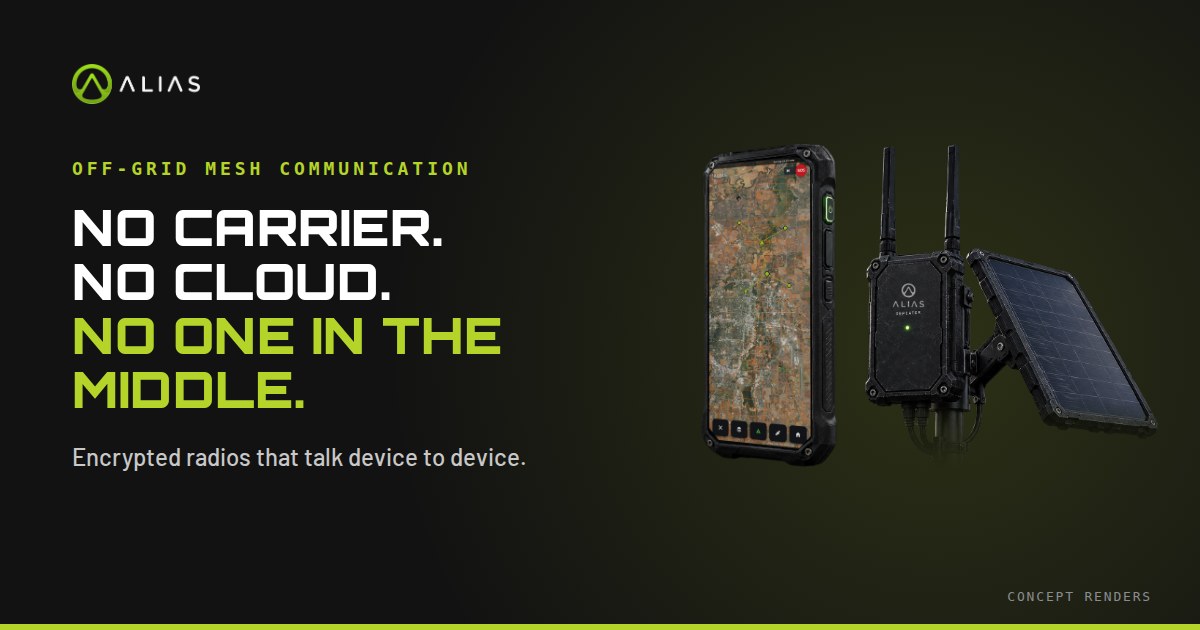
Images show concept renders. Final hardware may differ.
Most of us don't think much about how our phones communicate. You send a text, make a call, or pull up a map and it just works.
Until it doesn't.
Your phone isn't really talking directly to the person you're texting. It's connecting to a cell tower, which connects into a much larger network, and somewhere along the way your message gets routed where it needs to go.
That works incredibly well, but it also means we're dependent on a massive amount of infrastructure that we don't control.
A mesh network works differently.
So, What Is a Mesh Network?
The easiest way to explain it is that the devices themselves become part of the network.
Imagine five people spread out over several miles, each carrying a radio.
If Person A can't reach Person E directly, but they can reach Person B, and Person B can reach Person C, the message can move across the network until it reaches Person E.
Instead of: Device → Cell Tower → Carrier Network → Internet → Carrier Network → Cell Tower → Device
you can have: Device → Device → Device → Device
That's the basic idea behind a mesh network.
Each device is called a node. Depending on how the system is designed, those nodes can communicate directly with each other and can also help move information across the network.
That last part is what makes mesh interesting.
Why Does That Matter?
Radio has always had one fundamental problem: range.
No matter what somebody puts on the box, every radio has a limit.
Terrain matters. Buildings matter. Trees matter. Antenna height matters. The antenna itself matters. Even weather and interference can matter.
Put two radios on opposite sides of a mountain and you've got a completely different situation than putting those same radios on two hilltops with a clear line of sight.
Mesh networking doesn't magically eliminate those limitations.
What it can do is give the network more ways to get around them.
Say you're hunting with four other guys.
You're in a valley. One guy is a couple miles north of you. Another guy is sitting on a ridge. Someone else is on the other side of that ridge.
You might not be able to reach the guy on the other side directly.
But you may be able to reach the guy on top.
If his device can relay your message, suddenly you've extended your communication beyond what your individual radio could accomplish by itself.
Add more strategically placed nodes or repeaters and you can potentially extend that network considerably farther.
That's mesh.
It Doesn't Need a Cell Tower
This is probably the part that interests me the most.
A mesh network can be built without depending on traditional cellular infrastructure.
There doesn't have to be an AT&T or Verizon tower nearby. There doesn't necessarily need to be Wi-Fi. There doesn't have to be an internet connection somewhere in the middle just to move a message between two nearby devices.
The network can exist locally between the devices participating in it.
That's valuable in the backcountry where there isn't any service.
It's valuable during a natural disaster when infrastructure is overloaded or damaged.
It's valuable on large properties, ranches, job sites, hunting leases and anywhere else where normal cellular coverage is unreliable.
And it's valuable for people who simply don't want every form of communication they use dependent on a carrier or cloud service.
Mesh Isn't Magic
This is worth saying because there's a lot of confusion around radio range.
A mesh network doesn't mean you can put one device in Texas and another in Colorado and magically talk between them because they're both "mesh."
The nodes still have to be capable of communicating with another node somewhere along the route.
Think of it like people standing in a line passing a bucket.
If everybody is close enough to hand the bucket to the next person, you can move it a long way.
Remove the guy in the middle and suddenly you've got a problem.
Radio networks aren't exactly that simple, but it's a good way to visualize what's happening.
This is also why repeaters can be so useful. Instead of relying entirely on handheld devices moving around, you can place a node somewhere advantageous — high elevation is an obvious example — and use it to help extend coverage.
What Does LoRa Have to Do With It?
This is where things get particularly interesting for Alias.
LoRa stands for Long Range. It's a radio technology designed to move relatively small amounts of information over long distances while using very little power.
It's not 5G.
You're not going to stream Netflix over LoRa.
That's not what it was built for.
What it's very good at is moving small pieces of information efficiently over potentially significant distances.
Things like text messages, GPS coordinates, location information, sensor data, commands and alerts.
Pair that capability with a mesh network and now you can start building communication systems that don't depend on cellular infrastructure to function.
Where Rogue Fits In
This is a big part of what we're building with the Alias Rogue.
We don't want to build another gadget that becomes useless the second your phone loses service.
The goal is a standalone communication device designed around private, local communications.
Rogue is being designed to communicate directly with other devices over LoRa and to work as part of a larger network. We're also developing a repeater specifically to help extend that network.
There are still limitations. There always will be.
We're not going to tell you Rogue can magically communicate anywhere on Earth without infrastructure. That's not how RF works.
What we're trying to do is build useful infrastructure that you can actually own and control.
If you've got a group of Rogue devices and repeaters, that's your network.
Not ours.
Not Verizon's.
Not AT&T's.
Yours.
Why I Think This Matters
I don't think cellular networks are going anywhere, and I don't think they need to.
They're incredibly useful.
But I also don't think the answer to every communication problem should be: "Hopefully my phone has service."
We've gotten so used to infrastructure always being there that most people don't even think about what happens when it isn't.
For most people, that's just inconvenient.
But go far enough into the backcountry, have a tornado or hurricane knock infrastructure down, overload a cellular network during an emergency, or simply work somewhere with terrible coverage, and suddenly it matters quite a bit.
Mesh networking gives us another option.
And that's really what interests me about it.
Not replacing every existing communication system.
Building another one that doesn't depend on them.