Privacy Tech
When the Grid Goes Down, Your Family Shouldn't Go Silent
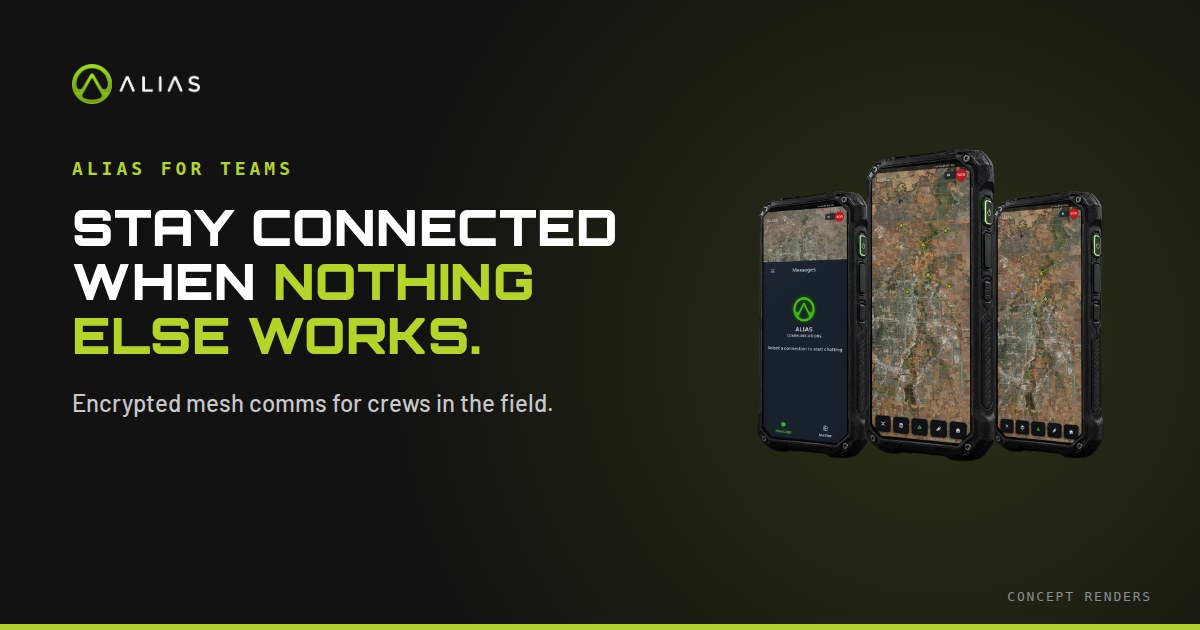
Images show concept renders. Final hardware may differ.
Think about the last time your phone lost signal. Now imagine it stays that way for three days — and your kids are across town.
That's not a doomsday fantasy. It's Hurricane Katrina. It's Puerto Rico in 2017, when 3.4 million people went weeks without connectivity. It's the Texas ice storm that silenced millions of households in 2021. Every one of those events had the same failure at its core: families depending entirely on infrastructure they don't own, operated by companies that don't answer to them, built for average days instead of the worst ones.
Modern communication runs through a long chain of other people's property — carrier towers, backhaul lines, cloud servers, data centers. When any link in that chain breaks, your family's ability to say "I'm safe, I'm here" breaks with it. And even on a good day, that chain is watching. Every message you send through carrier and cloud infrastructure generates records you'll never see, stored on servers you'll never control, monetized in ways you never agreed to.
Resilience and privacy turn out to be the same problem: dependency. Fix the dependency and you fix both.
A mesh network flips the model. Instead of every device reaching up to a distant tower, devices talk directly to each other — encrypted peer-to-peer, hopping from one device to the next until the message arrives. No carrier. No subscription. No single point of failure. The more devices in the mesh, the stronger it gets.
That's what we built the Alias Rogue to do. It's a rugged full-touchscreen handheld that carries your family's communication on hardware you own, over a network you control. Messages are encrypted end-to-end between devices, and the intelligence on board runs locally — no cloud processing, no data leaving your hands to be analyzed somewhere else. What your family says to each other stays with your family. That's not a feature toggle. It's the architecture.
Picture a family of five when a severe storm takes the local grid down. Dad is at the house. Mom is stuck at work across town. The oldest is at a friend's place two neighborhoods over. Cell service is gone — towers are dark or hopelessly overloaded.
Their Rogues don't notice. Messages hop device to device across the family mesh: "Power's out but we're fine." "Staying at Jake's until roads clear." "Come home when it's safe — take the back route." Locations shared, plans made, panic avoided. Not because the family had special training or expensive infrastructure — because they own their communication instead of renting it.
These are the four pillars everything Alias builds stands on, and a family mesh is where all four converge. Privacy, because encrypted peer-to-peer communication means no third party reads along. Sovereignty, because the network belongs to you, not a carrier. Resilience, because a mesh has no tower to knock down. And human ownership of data, because your family's words, locations, and patterns are yours — full stop.
The next outage isn't a hypothetical. It's a scheduling question. The only real decision is whether your family's lifeline belongs to someone else's infrastructure — or to you.
Ready to own your family's connection? Join the waitlist at aliascomms.com and be first in line when Alias Rogue ships.