Sovereignty
Your Neighborhood Doesn't Need the Internet to Talk to Itself
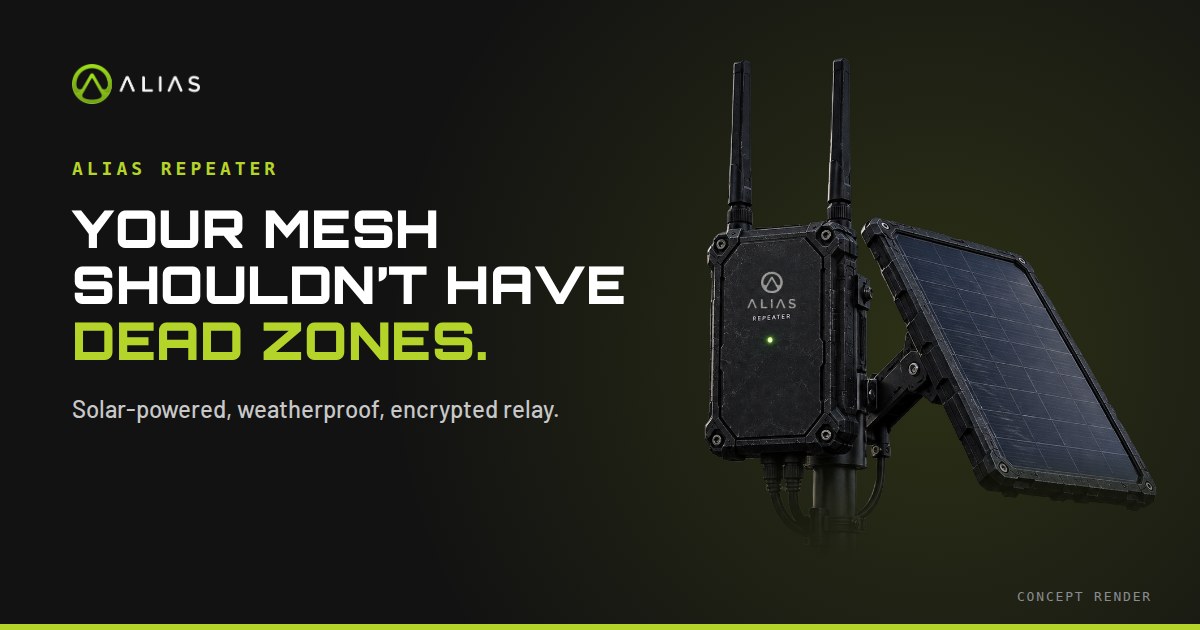
Images show concept renders. Final hardware may differ.
A block full of devices, and none of them talk to each other
Walk down almost any street in America and count the connected devices: video doorbells, smart locks, weather stations, baby monitors, dog collars with GPS. Every single one of them is wired the same way — straight up to a cloud server hundreds of miles away, and straight back down. Your neighbor's doorbell fifteen feet from yours has never once talked directly to your porch light, even though they're standing in the exact same storm.
That's not an accident. It's the business model. Cloud-first devices need you dependent on a subscription and a data center, not on each other. So an entire neighborhood full of "smart" homes ends up with zero local intelligence — just dozens of separate umbilical cords running to the same handful of companies.
Every device you add makes the network stronger, not weaker
Alias devices work differently because they're built on mesh, not cloud. Each handheld and Homebase unit can relay messages for the ones around it over encrypted peer-to-peer links — no internet, no carrier, no subscription required. That means the more Alias devices exist in a given area, the farther and more reliably messages travel, hopping house to house instead of climbing to a server room and back.
A cul-de-sac loses cell coverage during a storm
Picture a dead-end street of six houses after a summer storm knocks out the nearest cell tower. Phones show no bars. In a normal neighborhood, that's it — everyone is isolated until a repair crew shows up, sometimes days later.
With Alias in even two or three of those homes, it plays out differently. One family's Homebase, still running on battery backup, relays a message from another family three doors down who need a hand with a fallen branch. A neighbor watching an elderly resident's porch camera — processed locally, never routed through a cloud — notices she hasn't come outside and sends a check-in ping over the mesh. None of it touches the internet. None of it waits for a company's servers to come back online. The neighborhood becomes its own infrastructure, because the intelligence was never centralized to begin with.
Sovereignty scales with community, not against it
This is the part cloud companies never advertise: their model gets weaker the more people depend on it in a crisis — more load, more congestion, more single points of failure. A mesh gets stronger. Every additional Alias device is another relay point, another possible path for a message to find its way home.
We built Alias on four pillars — Privacy, Sovereignty, Resilience, and Human Ownership of Data — and a neighborhood mesh is where all four show up at once. Nobody's conversations are captured. Nobody's location history sits in a database. And when the grid or the carriers fail, the community doesn't go dark — it just talks to itself.
Join the waitlist at aliascomms.com, and help make your street one that doesn't need permission to stay connected.